Named not in hubris but in honor and memory of Austin M. Wright, who taught me critical thinking, and his teacher, Wayne Booth, who coined the phrase.

Showing posts with label Chaim Weizmann. Show all posts

Friday, August 31, 2012

The SS President Arthur: The Zionist Mayflower Part IX: A Dream Goes Up in Smoke


Five weeks after Strahl claimed to buying another ship, the company was in receivership. With assets valued at $1 million and liabilities of $300,000, American Palestine Lines released a statement that put a most positive spin on its situation, claiming that the action was “the best means of preserving the interests not only of creditors . . . but also its stockholders, who have invested in this enterprise not only for financial reasons but also in furtherance of the plan of opening up direct communication with the Holy Land.” Ever hopeful, the general manager reported, “active negotiations already have begun to put the [company] on a sound and profitable basis financially. These plans include the acquisition of at least two new steamers.” [i]

It was not to be. A week later, a small item at the bottom of page 28 of the September 20 New York Times reported “Fire on President Arthur.” Five mattresses had caught fire, and the “flames spread quickly to the walls of the room and to the forward companion stairway leading to the engine room.”[ii] Damage was estimated at only $500, but it permanently damaged this particular Zionist dream, though publicly no one was willing to let go. The Palestine Bulletin reported on September 21, “We have been asked by Mr. L.M. Jeune, Manager and General Agent of the American Palestine Line . . . Notice has appeared in some of the local papers to the effect that the . . . Line has been disolved [sic] and that another Company has been floated. I wish to deny this statement . . . ”[iii] On September 30, the Bulletin noted, “We are officially informed that the ss. ‘President Arthur’ will sail from New York on the 14th October and arrive at Haifa on the 1st November.”[iv]

By December 1925, events were moving swiftly downhill. On the 3rd, charges of fraud were filed as part of a bankruptcy suit by two insurance companies and others. They alleged that the officers knew the company was insolvent even as they had borrowed additional funds; moreover, some officers were also charged with falsifying financial statements.[v]

Less than two weeks later, Joseph W. Gottlieb, secretary of the American Palestine Line, filed a response that “denied all charges reflecting upon the honesty of the line’s officers.” The complicated response to other charges in the bankruptcy petition included an explanation of a counterclaim against the Morse Drydock Company, which had allegedly made negligent repairs to the ship. In addition to the court filing, Gottlieb released a letter:  “We desire to make it clear that although Justice Strahl is President of the American Palestine Line, Inc., he at no time received compensation and that no provision that he receive compensation at any time in the future had been made. He gave his services unstintingly for an ideal alone.” [vi]

On December 21, 1925, thirteen months after the announcement of its purchase, the President Arthur “was sold at auction in foreclosure proceedings.”[vii] While the ship itself had been purchased for only $60,000, the company still owed much of the $500,000 that had been spent on refurbishing it. Interestingly, many of the details of the financial downfall appeared only in the Canadian Jewish Review, and not – given all the previous coverage – the New York Times.[viii]

There was one other commercial attempt to promote Palestine travel and tourism in the 1930s. In 1933, the Gdynia-America Line “established a new service to Palestine to accommodate Polish-Jewish communities in the United States.”[ix] While the president of the line claimed that “the new service . . . would provide the most economical means” of travel, it was certainly not the most direct. Passengers would sail from New York to Gdynia, a port about 35 miles northwest of Gdansk, “travel through Poland by train to Constanza,” a Rumanian city on the Baltic, then board a ship – the Polonia – that would take them to Palestine via Istanbul.

Jacob S. Strahl continued to play a leading – and highly visible – role in American Zionist activities. He remained president of the Judea Industrial Corporation, a holding company for two insurance companies that represented “business men who are interested in the economical development of Palestine.”[x] When he died in 1965 after several terms on the bench, his obituary noted that as the first chairman of the American Jewish Congress he had accompanied Chaim Weizmann in 1925 “on a tour from New York to St. Louis when Dr. Weizmann introduced the Palestine Foundation Fund (Keren Hayesod) to America.”[xi]
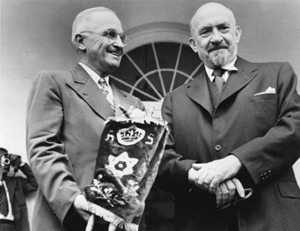
President Harry S Truman and Chaim Weizmann, May 25, 1948

In September 1948, well before Strahl died, El Al Airlines had made its first flight, bringing Chaim Weizmann home from a conference in Geneva, Switzerland, to Israel.[xii] Americans can now travel from New York to Tel Aviv in about 15 hours. Strahl was a visionary and an entrepreneur but perhaps not a shrewd businessman.


[i]  “Palestine Ship Line in Receiver’s Hands,” New York Times, September 12, 1925, 7.
[ii]  “Fire on President Arthur,” New York Times, September 20, 1925, 28.
[iii]  “A Denial,” Palestine Bulletin, September 21, 1925, p. 3.
[iv]  “S S ‘President Arthur’s’ Sailings,” Palestine Bulletin, September 30, 1925.
[v]  “Say Palestine Line Got Bond by Fraud,” New York Times, December 4, 1925, 11.
[vi]  “Palestine Line Upholds Officers,” New York Times, December 15, 1925, Radio section, 18.
[vii]  “Liner Sold for $137,500,” New York Times, December 22, 1925, Financial section, 29.
[viii]  “Palestine Line in a Tempest of Financial Turmoil,” Canadian Jewish Review, November 13, 1925, 20.
[ix]  “Gdynia Line to Open Palestine Service,” New York Times, September 8, 1933, Weather reports, Shipping and Mails section, 39. There is one recorded arrival of the Polonia in late October 1933, at a time when demonstrations against Jewish immigration to Palestine were flaring up throughout the country. Scheduled to land at Jaffa on November 1 with “several hundred Jewish immigrants,” the Polonia was redirected to Port Said. From there, according to an article a week later, “about 1,000 immigrants” would take the train to Palestine. (Joseph M. Levy, “Jerusalem Scene of Arab Rioting; 3 Killed, 70 Hurt,” New York Times, October 30, 1933, 1; and Levy, “Wauchope Orders Release of Arabs,” November 6, 1933, Radio section 16.
[x]  “Celebrate Stock Sale,” New York Times, August 15, 1927, 11.
[xi]  “Jacob Strahl, 88, Ex-Judge, is Dead,” New York Times, January 14, 1965, 81. In fact, this controversial trip was in 1921; whether or not Strahl was with him is not recorded.
[xii]  http://www.elal.co.il/ELAL/English/AboutElAl/.

Wednesday, August 1, 2012

The SS President Arthur: The Zionist Mayflower, Part V: The Travelers

The owners of the President Arthur had cast a large net for passengers, and the group that left New York on March 12, 1925, had many different reasons for going.  Among the passengers were:
Philip Wattenberg
  • Philip Wattenberg, president of the American Palestine Line and a builder, who “plans to build hundreds of homes in Palestine for Jews who return there from other countries.”[i]
  • Gizella Wattenberg, his 23-year-old daughter, who was stoned near Nablus later in her trip.[ii] “The only apparent reason for the attack,” the New York Times wrote three months later when she returned to New York, “is that Nablus is a fanatical part of the country.” [iii]
  • Professor Arie Abileah, a pianist whose father composed the music for the Ma Nishtanah.
  • H. Eisenberg, 67, of Astoria, Queens. A florist, he was carrying with him “more than 12,000 plants and shrubs which he intends to plant in a memorial park in the Holy Land. Mr. Eisenberg was sworn in as a Deputy Sheriff yesterday afternoon by Sheriff Mason O. Smedley of Queens, and will wear his gold badge during the three months he is in Palestine.”[iv]
  • Abraham Goodall, an organizer and official of the steamship line, and his new bride, Ruth Lieberech, both of the Bronx, who had been married on March 8, 1925, on the roof of the home of David de Sola Pool. Reporting on the wedding, performed “in Open According to Palestinian Custom” the Times noted that the parents of both bride and groom “were among the founders of the Petach Tikvah, a Jewish colony in the Holy Land.”[v]
Although the ceremony marking the founding of Hebrew University was not featured in the advance publicity, it was the primary destination of Herman Hirsch and many of his shipmates. Others were responding to the call of Nathan Straus to rebuild Zion; still others went to visit Zion but not make a lifetime commitment.  Whatever their reasons for travel, passengers on the SS President Arthur's maiden voyage were tracked as the American Palestine Line's offices continued its transoceanic hype.

Thanks in part perhaps to the “high-power radio,” the press monitored the ship's progress. On its March 17, 1925, photo page, the Christian Science Monitor featured the ship’s Irish captain, W.J. Breen, with the “first woman officers on an ocean liner”: Bernice P. Schmitt and Rebecca Adelman.[vii]  On March 18, the New York Times reported: “First and second cabin passenger enjoying trip enthusiastically.”[viii]


Describing the first Sabbath on the ship, Hirsch wrote,
On Friday, March 13, we dedicated the Torah. A procession was formed and with songs and music we marched all over the ship. A chapel was provided and fitted suitable for services, and decorated with flags and flowers. Rabbi Ashinsky from Pittsburgh officiated and after his splendid sermon there was much rejoicing and singing.[xi]

Twelve days out of New York, the only other noteworthy event was recorded by Hirsch: 
It was on the 24th day of March that one of the passengers – Mr. Jacob Drapekin of Chicago, who was making the trip to spend his last years in Palestine – died on the ship. After consultation with the Captain and Officers, Mr. Drapekin’s last request was granted – to be buried in the Holy Land.[xii]
On Thursday, March 26, as the President Arthur sailed through the Straits of Gibraltar, the crew and passengers saw a “huge” water spout, and changed course “to avoid the phenomenon.” As usual, this news was reported by by the offices of the American Palestine Line to the Times.  From there to Haifa, the ship was escorted by a special ship chartered by “members of the Jewish community at Gibraltar.” [xiii]

On March 29, the New York Times reported that the ship “is due to arrive at Haifa today,” having “arrived at and departed from Naples on Friday [March 27].” The Times printed a statement by Strahl:  “Lord Balfour, who accompanied Dr. Chaim Weizmann to Jerusalem to attend the dedication of the first Hebrew University . . . is expected to come down from the Holy City to greet the modern Mayflower.”[xiv]


[i]  “Zionists Sail for Dedication of University.”
[ii]  “Several Persons Wounded at Nablus,” Palestine Bulletin, April 8, 1925, 1. “Official Statement on Nablus Incident,” Palestine Bulletin, April 12, 1925.
[iii]  “American Tourists Flogged by Arabs,” New York Times, July 4, 1925, 3. The Times article concludes:  “when Miss Wattenberg was in Egypt several weeks later a fellow-traveler told her that some of the guilty Arabs had been arrested.” Herman Hirsch also describes the attack:
We encountered Arabs who offered to rent us their donkeys so that we could ride up the mountain, and after making the bargain with them we mounted the animals. Upon reaching about one-half the distance the Arabs demanded pay again. We refused and dismounted and began walking again. When within a distance of about eight hundred or a thousand feet from our destination a group of Arabs, about twenty-five or thirty in number, barred our way, refusing us passage. There was nothing else to do but to retrace our steps. As we started on our return journey the Arabs started to throw stones at us. One of the women in our party was hit and she fell down, bleeding. Then the cry came for us to run for our lives. One stone grazed my head, another my back. An arab hit me on the back with a heavy stick and tore from my shoulder my kodak which hung there. I surely thought that this would be my end. They had knives. O how I did run over the rough stones - my mouth so dry that I could hardly breath [sic]. I had, however, provided myself with some Holland gin, I hurriedly placed it to my lips and took a drink. That gave me new strength, and after repeating this a few times as I ran, I was able to gather up all my strength. I reached the hotel in safety, and a short time later the others in our party came straggling in and with them the wounded member who received the proper attention.
[iv]  “City Bids Godspeed to Holy Land Ship.”
[v]  “Marry on the Roof of Rabbi Pool’s Home,” New York Times, March 9, 1925, 17.
[vi]  William J. Breen, Master. “List or Manifest of Aliens Employed on the Vessel as Members of Crew,” USMSS President Arthur arriving at New York, May 8, 1925, from the port of Haifa, Palestine, Sheet No. 206, No. 1. http://search.ancestry.com/Browse/view.aspx?dbid=7488&iid=NYT715_3648-1128. Accessed 12/8/09.
[vii]  “Women on High Seas,” Christian Science Monitor, March 17, 1925, 9.
[viii]  “Passengers for Palestine Enjoying Trip, Says a Radio,” New York Times, March 18, 1925, 23.
[ix]  ibid.
[x]  Hirsch, op.cit.
[xi]  Hirsch, op.cit.  Rabbi Aaron Mordecai Ashinsky (1867-1954) of Pittsburgh was a founder of the Mizrachi Movement. He and his wife Pearl and their daughter Esther returned to New York from Palestine on the second round trip of the “President Arthur” on July 14, 1925. “List of United States Citizens for the Immigration Authorities,” Arrivals at Port of New York July 14, 1925. http://search.ancestry.com/Browse/view.aspx?dbid=7488&path=1925.07.14.President+Arthur.3&sid=&gskw. Accessed November 30, 2009.
[xii]  Hirsch, op.cit.
[xiii]  “Sights Huge Water Spout.” New York Times, March 27, 1925, 13.
[xiv]  “Zion Liner Due at Haifa,” New York Times, March 29, 1925, E2. In fact, long before the ship had left New York, American Palestine Line officials reported that they had received a letter from Chaim Weizmann that he would welcome the travelers in Haifa (“Dr. Weizmann to Welcome Tourist on ‘President Arthur,’” Chicago Daily Jewish Courier, March 10, 1925).