Named not in hubris but in honor and memory of Austin M. Wright, who taught me critical thinking, and his teacher, Wayne Booth, who coined the phrase.

Showing posts with label Joseph Gottlieb. Show all posts

Friday, August 31, 2012

The SS President Arthur: The Zionist Mayflower Part IX: A Dream Goes Up in Smoke


Five weeks after Strahl claimed to buying another ship, the company was in receivership. With assets valued at $1 million and liabilities of $300,000, American Palestine Lines released a statement that put a most positive spin on its situation, claiming that the action was “the best means of preserving the interests not only of creditors . . . but also its stockholders, who have invested in this enterprise not only for financial reasons but also in furtherance of the plan of opening up direct communication with the Holy Land.” Ever hopeful, the general manager reported, “active negotiations already have begun to put the [company] on a sound and profitable basis financially. These plans include the acquisition of at least two new steamers.” [i]

It was not to be. A week later, a small item at the bottom of page 28 of the September 20 New York Times reported “Fire on President Arthur.” Five mattresses had caught fire, and the “flames spread quickly to the walls of the room and to the forward companion stairway leading to the engine room.”[ii] Damage was estimated at only $500, but it permanently damaged this particular Zionist dream, though publicly no one was willing to let go. The Palestine Bulletin reported on September 21, “We have been asked by Mr. L.M. Jeune, Manager and General Agent of the American Palestine Line . . . Notice has appeared in some of the local papers to the effect that the . . . Line has been disolved [sic] and that another Company has been floated. I wish to deny this statement . . . ”[iii] On September 30, the Bulletin noted, “We are officially informed that the ss. ‘President Arthur’ will sail from New York on the 14th October and arrive at Haifa on the 1st November.”[iv]

By December 1925, events were moving swiftly downhill. On the 3rd, charges of fraud were filed as part of a bankruptcy suit by two insurance companies and others. They alleged that the officers knew the company was insolvent even as they had borrowed additional funds; moreover, some officers were also charged with falsifying financial statements.[v]

Less than two weeks later, Joseph W. Gottlieb, secretary of the American Palestine Line, filed a response that “denied all charges reflecting upon the honesty of the line’s officers.” The complicated response to other charges in the bankruptcy petition included an explanation of a counterclaim against the Morse Drydock Company, which had allegedly made negligent repairs to the ship. In addition to the court filing, Gottlieb released a letter:  “We desire to make it clear that although Justice Strahl is President of the American Palestine Line, Inc., he at no time received compensation and that no provision that he receive compensation at any time in the future had been made. He gave his services unstintingly for an ideal alone.” [vi]

On December 21, 1925, thirteen months after the announcement of its purchase, the President Arthur “was sold at auction in foreclosure proceedings.”[vii] While the ship itself had been purchased for only $60,000, the company still owed much of the $500,000 that had been spent on refurbishing it. Interestingly, many of the details of the financial downfall appeared only in the Canadian Jewish Review, and not – given all the previous coverage – the New York Times.[viii]

There was one other commercial attempt to promote Palestine travel and tourism in the 1930s. In 1933, the Gdynia-America Line “established a new service to Palestine to accommodate Polish-Jewish communities in the United States.”[ix] While the president of the line claimed that “the new service . . . would provide the most economical means” of travel, it was certainly not the most direct. Passengers would sail from New York to Gdynia, a port about 35 miles northwest of Gdansk, “travel through Poland by train to Constanza,” a Rumanian city on the Baltic, then board a ship – the Polonia – that would take them to Palestine via Istanbul.

Jacob S. Strahl continued to play a leading – and highly visible – role in American Zionist activities. He remained president of the Judea Industrial Corporation, a holding company for two insurance companies that represented “business men who are interested in the economical development of Palestine.”[x] When he died in 1965 after several terms on the bench, his obituary noted that as the first chairman of the American Jewish Congress he had accompanied Chaim Weizmann in 1925 “on a tour from New York to St. Louis when Dr. Weizmann introduced the Palestine Foundation Fund (Keren Hayesod) to America.”[xi]
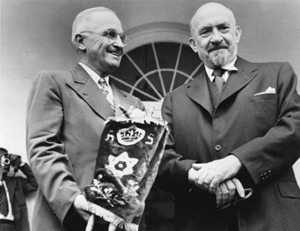
President Harry S Truman and Chaim Weizmann, May 25, 1948

In September 1948, well before Strahl died, El Al Airlines had made its first flight, bringing Chaim Weizmann home from a conference in Geneva, Switzerland, to Israel.[xii] Americans can now travel from New York to Tel Aviv in about 15 hours. Strahl was a visionary and an entrepreneur but perhaps not a shrewd businessman.


[i]  “Palestine Ship Line in Receiver’s Hands,” New York Times, September 12, 1925, 7.
[ii]  “Fire on President Arthur,” New York Times, September 20, 1925, 28.
[iii]  “A Denial,” Palestine Bulletin, September 21, 1925, p. 3.
[iv]  “S S ‘President Arthur’s’ Sailings,” Palestine Bulletin, September 30, 1925.
[v]  “Say Palestine Line Got Bond by Fraud,” New York Times, December 4, 1925, 11.
[vi]  “Palestine Line Upholds Officers,” New York Times, December 15, 1925, Radio section, 18.
[vii]  “Liner Sold for $137,500,” New York Times, December 22, 1925, Financial section, 29.
[viii]  “Palestine Line in a Tempest of Financial Turmoil,” Canadian Jewish Review, November 13, 1925, 20.
[ix]  “Gdynia Line to Open Palestine Service,” New York Times, September 8, 1933, Weather reports, Shipping and Mails section, 39. There is one recorded arrival of the Polonia in late October 1933, at a time when demonstrations against Jewish immigration to Palestine were flaring up throughout the country. Scheduled to land at Jaffa on November 1 with “several hundred Jewish immigrants,” the Polonia was redirected to Port Said. From there, according to an article a week later, “about 1,000 immigrants” would take the train to Palestine. (Joseph M. Levy, “Jerusalem Scene of Arab Rioting; 3 Killed, 70 Hurt,” New York Times, October 30, 1933, 1; and Levy, “Wauchope Orders Release of Arabs,” November 6, 1933, Radio section 16.
[x]  “Celebrate Stock Sale,” New York Times, August 15, 1927, 11.
[xi]  “Jacob Strahl, 88, Ex-Judge, is Dead,” New York Times, January 14, 1965, 81. In fact, this controversial trip was in 1921; whether or not Strahl was with him is not recorded.
[xii]  http://www.elal.co.il/ELAL/English/AboutElAl/.

Wednesday, August 15, 2012

The SS President Arthur: The Zionist Mayflower Part VII: A Troubled Return to New York

While the Jewish world’s attention turned largely to the ceremonies marking the opening of Hebrew University, Judge Strahl continued to ensure that his ship remained in the public eye. On April 8, the New York Times announced:  “Passengers on President Arthur Pledge $500,000 for Project.”[i] 

The article was ostensibly a “response to numerous inquiries concerning the $190,000 gift made by Philip Wattenberg of New York.” In fact, Strahl declared, “the passengers had called a mass meeting aboard ship and raised the nucleus of a fund” totaling “nearly $500,000 for the erection of a new city in Palestine, to be called Zebulun.” The letter from Strahl to the Times continued,
Before sailing these pilgrims promised that something really constructive for the upbuilding of Palestine would be done, by them. They were determined that suitable hotels should be erected at Tiberias and Haifa, and laid other plans for the practical demonstration of the American Jews’ desire to help in the reconstruction of the Holy Land.[ii]

These hotels, the Courier noted, would be “Modern Hotels on American Style.”[iii] Zebulun was never built, nor were the hotels, and where the money went was never revealed.

The Courier, among other Jewish press outlets, attested to the obvious cascade of press releases and special bulletins emanating from the offices of the American Palestine Line. On April 21, in fact, there were no less than four articles about the President Arthur.[iv] The April 28 issue continued the litany of announcements about the ship and its passengers: “Jewish Bankers to Study Palestine:  Represent Capital of Billion Dollars,” “President Arthur Sets Sail for America; Plan Gala Reception Here,” “Plan Palestine Touring Parties from Many Cities.”[v]

The return trip did not go so smoothly, however. A “special cable dispatch” in the Washington Post on April 24 reported “Amreican [sic] Seamen Clash With Fascisti.” According to this brief article,
The seamen quarreled among themselves about a bill for refreshments. Several fascists, dressed in black shirts and full regalila [sic], including clubs, intervened. . . . fifteeen [sic] Americans swam to their steamer to evade the police.[vi]

Joseph Gottlieb
A different account of the incident – from the crew’s perspective – appeared in the New York Times the morning after the President Arthur arrived in New York, dismissing it as sailors becoming “involved” with the local police in Naples “and three were locked up.”[vii] More significant, however, were rumors that the crew had mutinied on the return voyage. The ship was met by police captains, sergeants, detectives, twenty uniformed patrolmen, and four mounted police officers. There had been no mutiny, but police arrested Hyman Epstein, general manager of the American Palestine Line, on a charge by the secretary of the line, Joseph W. Gottlieb, that Epstein had misappropriated $500. “A thorough reorganization of the line as well as changes in the personnel will be effected shortly,” reported the Palestine Bulletin.[viii]

Poor Epstein! A year later, the Canadian Jewish Review, detailing the collapse of the shipping line, reported that Epstein had spent his first night back in jail because he could not raise the $5,000 bail. Even worse,
When he was arraigned, it is declared that an attempt was made to have him committed to Bellevue for observation, and again at a subsequent hearing Gottlieb tried to have the proceedings against Epstein changed to an inquiry into his sanity.[ix]
Hyman Epstein

Epstein was indicted on a charge of grand larceny; the charge was dismissed by the judge; Epstein sued six officers of the shipping line for “malicious prosecution” and asked for $350,000 in damages. Three years later, after a one-day trial, the six “signed a statement exonerating Epstein from any charge of misappropriating funds,” which Epstein claimed was all he really wanted. [x]

The Times article describing the return of the ship also bodes ill, however, in its note that “147 passengers were on board.” Although the ship was due on May 3,[xi] it actually arrived on Friday night, May 9, at 11 p.m. The late Sabbath eve arrival kept the crowd meeting the ship to “less than 500 persons,” who sang Hatikvah with the arriving passengers; the crew outnumbered the passengers by two-to-one. Sharing the space were 75,000 bags of onions from Egypt; 16,000 cases of lemons from Italy; and “two boxes of Jaffe oranges for Nathan Straus . . . as a token of appreciation from the fruit growers of Palestine.” [xii]


[i]  “Start Fund to Build a City in Palestine,” New York Times, April 8, 1925, Business Opportunities section, 44.
[ii]  ibid.
[iii]   “To Build Modern Hotel on American Style in Haifa,” Chicago Jewish Daily Courier, April 21, 1925.
[iv]   “Jewish Steamer to Use Same Pier as the Leviathan,” “Stahl Confirms Building of Merchant Marine City in Palestine,” “Pravda, Official Organ of Soviet Russia, Comments on Jewish Steamer,” Chicago Jewish Daily Courier, April 21, 1925.
[v]   Chicago Jewish Daily Courier, April 28, 1925.
[vi]  Washington Post, April 24, 1925, 1.
[vii]  “Big Police Squad Meets Jewish Ship,” New York Times, May 9, 1925, 6.
[viii]  “S.S. ‘President Arthur’ Met by Police,” Palestine Bulletin, May 11, 1925, 1.
[ix]  “Palestine Line in a Tempest of Financial Turmoil,” Canadian Jewish Review, November 13, 1925, 23.
[x]  “Six Exonerate Epstein,” New York Times, June 20, 1928, Steamships and Tours section, 52.
[xi]  “Pier 86 for Palestine Liner,” New York Times, April 11, 1925, 3.
[xii]  “Big Police Squad Meets Jewish Ship.”