Named not in hubris but in honor and memory of Austin M. Wright, who taught me critical thinking, and his teacher, Wayne Booth, who coined the phrase.

Showing posts with label SS President Arthur. Show all posts

Friday, September 7, 2012

The Zionist Mayflower, Part X: Were your Relatives on the SS President Arthur?

Exactly who was on the three voyages of the SS President Arthur is of most interest to genealogists exploring their families' histories.  In 1925, the U.S. did not maintain lists of travelers departing the U.S., but a partial and not-totally-reliable list can be cobbled together from a number of sources.
   
The New York Times of March 12, 1925 (page 22), names 322 passengers, although a subhead on the article is “500 to sail this morning.” My great-grandfather, Jacob Drapekin, is not listed; he was a second-class passenger, and it is possible that the Times included only first-class passengers. Others not listed were officials of the American-Palestine Line, such as Philip Wattenberg, his wife and his daughter.

The Central Zionist Archives in Jerusalem has arrival lists, but there are some shortcomings.  One is that they do not list where the passenger boarded the ship.  Because the SS President Arthur stopped at Naples en route to Haifa, one cannot determine if a passenger embarked from New York or Naples.

A Central Zionist Archives list with 184 names and ages of people arriving in Palestine on March 31, 1925, includes some who had not been on the Times list (the Wattenberg family).  It is typed in Hebrew and it is legible.  Contact familyresearch@jazo.org.il and request ISA1/15489/2.

A Central Zionist Archives list with 167 names and ages of people arriving in Palestine on May 31, 1925, the second voyage of the SS President Arthur, is also in Hebrew and typed. It is called a “List of Immigrants” (Olim), but clearly not all are immigrants; many names can be found on either the U.S. manifests of returning passengers on the SS President Arthur or other ships.  This list (S104/560) was mistakenly referred to as the “Prince Arthur” by the archivist and wrongly dated 1924.  Go there if you can, but if you cannot, be persistent!  I suspect other pages have been misfiled.

Similarly incomplete and inaccurate are the manifests of citizens returning to the U.S. on the President Arthur on May 8, 1925; July 14, 1925; and September 18, 1925 (all microfilmed and on-line at www.ancestry.com).  The on-line manifest of July 14 includes the same page copied nine times.  Unfortunately I learned from a query to the National Archives that the original manifests were destroyed after being microfilmed many years ago.

The Mariners' Museum Library at Christopher Newport University, Newport News, VA, has brochures, charts, and other materials relating to the SS President Arthur at the time it was owned by the American Palestine Line.  They are from the collection of Lt. Col. Richard Newman, USA. Information about all of the library's rich holding are online.  

Happy hunting!

Friday, August 31, 2012

The SS President Arthur: The Zionist Mayflower Part IX: A Dream Goes Up in Smoke


Five weeks after Strahl claimed to buying another ship, the company was in receivership. With assets valued at $1 million and liabilities of $300,000, American Palestine Lines released a statement that put a most positive spin on its situation, claiming that the action was “the best means of preserving the interests not only of creditors . . . but also its stockholders, who have invested in this enterprise not only for financial reasons but also in furtherance of the plan of opening up direct communication with the Holy Land.” Ever hopeful, the general manager reported, “active negotiations already have begun to put the [company] on a sound and profitable basis financially. These plans include the acquisition of at least two new steamers.” [i]

It was not to be. A week later, a small item at the bottom of page 28 of the September 20 New York Times reported “Fire on President Arthur.” Five mattresses had caught fire, and the “flames spread quickly to the walls of the room and to the forward companion stairway leading to the engine room.”[ii] Damage was estimated at only $500, but it permanently damaged this particular Zionist dream, though publicly no one was willing to let go. The Palestine Bulletin reported on September 21, “We have been asked by Mr. L.M. Jeune, Manager and General Agent of the American Palestine Line . . . Notice has appeared in some of the local papers to the effect that the . . . Line has been disolved [sic] and that another Company has been floated. I wish to deny this statement . . . ”[iii] On September 30, the Bulletin noted, “We are officially informed that the ss. ‘President Arthur’ will sail from New York on the 14th October and arrive at Haifa on the 1st November.”[iv]

By December 1925, events were moving swiftly downhill. On the 3rd, charges of fraud were filed as part of a bankruptcy suit by two insurance companies and others. They alleged that the officers knew the company was insolvent even as they had borrowed additional funds; moreover, some officers were also charged with falsifying financial statements.[v]

Less than two weeks later, Joseph W. Gottlieb, secretary of the American Palestine Line, filed a response that “denied all charges reflecting upon the honesty of the line’s officers.” The complicated response to other charges in the bankruptcy petition included an explanation of a counterclaim against the Morse Drydock Company, which had allegedly made negligent repairs to the ship. In addition to the court filing, Gottlieb released a letter:  “We desire to make it clear that although Justice Strahl is President of the American Palestine Line, Inc., he at no time received compensation and that no provision that he receive compensation at any time in the future had been made. He gave his services unstintingly for an ideal alone.” [vi]

On December 21, 1925, thirteen months after the announcement of its purchase, the President Arthur “was sold at auction in foreclosure proceedings.”[vii] While the ship itself had been purchased for only $60,000, the company still owed much of the $500,000 that had been spent on refurbishing it. Interestingly, many of the details of the financial downfall appeared only in the Canadian Jewish Review, and not – given all the previous coverage – the New York Times.[viii]

There was one other commercial attempt to promote Palestine travel and tourism in the 1930s. In 1933, the Gdynia-America Line “established a new service to Palestine to accommodate Polish-Jewish communities in the United States.”[ix] While the president of the line claimed that “the new service . . . would provide the most economical means” of travel, it was certainly not the most direct. Passengers would sail from New York to Gdynia, a port about 35 miles northwest of Gdansk, “travel through Poland by train to Constanza,” a Rumanian city on the Baltic, then board a ship – the Polonia – that would take them to Palestine via Istanbul.

Jacob S. Strahl continued to play a leading – and highly visible – role in American Zionist activities. He remained president of the Judea Industrial Corporation, a holding company for two insurance companies that represented “business men who are interested in the economical development of Palestine.”[x] When he died in 1965 after several terms on the bench, his obituary noted that as the first chairman of the American Jewish Congress he had accompanied Chaim Weizmann in 1925 “on a tour from New York to St. Louis when Dr. Weizmann introduced the Palestine Foundation Fund (Keren Hayesod) to America.”[xi]
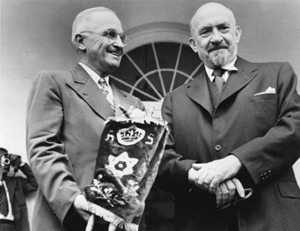
President Harry S Truman and Chaim Weizmann, May 25, 1948

In September 1948, well before Strahl died, El Al Airlines had made its first flight, bringing Chaim Weizmann home from a conference in Geneva, Switzerland, to Israel.[xii] Americans can now travel from New York to Tel Aviv in about 15 hours. Strahl was a visionary and an entrepreneur but perhaps not a shrewd businessman.


[i]  “Palestine Ship Line in Receiver’s Hands,” New York Times, September 12, 1925, 7.
[ii]  “Fire on President Arthur,” New York Times, September 20, 1925, 28.
[iii]  “A Denial,” Palestine Bulletin, September 21, 1925, p. 3.
[iv]  “S S ‘President Arthur’s’ Sailings,” Palestine Bulletin, September 30, 1925.
[v]  “Say Palestine Line Got Bond by Fraud,” New York Times, December 4, 1925, 11.
[vi]  “Palestine Line Upholds Officers,” New York Times, December 15, 1925, Radio section, 18.
[vii]  “Liner Sold for $137,500,” New York Times, December 22, 1925, Financial section, 29.
[viii]  “Palestine Line in a Tempest of Financial Turmoil,” Canadian Jewish Review, November 13, 1925, 20.
[ix]  “Gdynia Line to Open Palestine Service,” New York Times, September 8, 1933, Weather reports, Shipping and Mails section, 39. There is one recorded arrival of the Polonia in late October 1933, at a time when demonstrations against Jewish immigration to Palestine were flaring up throughout the country. Scheduled to land at Jaffa on November 1 with “several hundred Jewish immigrants,” the Polonia was redirected to Port Said. From there, according to an article a week later, “about 1,000 immigrants” would take the train to Palestine. (Joseph M. Levy, “Jerusalem Scene of Arab Rioting; 3 Killed, 70 Hurt,” New York Times, October 30, 1933, 1; and Levy, “Wauchope Orders Release of Arabs,” November 6, 1933, Radio section 16.
[x]  “Celebrate Stock Sale,” New York Times, August 15, 1927, 11.
[xi]  “Jacob Strahl, 88, Ex-Judge, is Dead,” New York Times, January 14, 1965, 81. In fact, this controversial trip was in 1921; whether or not Strahl was with him is not recorded.
[xii]  http://www.elal.co.il/ELAL/English/AboutElAl/.

Wednesday, August 15, 2012

The SS President Arthur: The Zionist Mayflower Part VII: A Troubled Return to New York

While the Jewish world’s attention turned largely to the ceremonies marking the opening of Hebrew University, Judge Strahl continued to ensure that his ship remained in the public eye. On April 8, the New York Times announced:  “Passengers on President Arthur Pledge $500,000 for Project.”[i] 

The article was ostensibly a “response to numerous inquiries concerning the $190,000 gift made by Philip Wattenberg of New York.” In fact, Strahl declared, “the passengers had called a mass meeting aboard ship and raised the nucleus of a fund” totaling “nearly $500,000 for the erection of a new city in Palestine, to be called Zebulun.” The letter from Strahl to the Times continued,
Before sailing these pilgrims promised that something really constructive for the upbuilding of Palestine would be done, by them. They were determined that suitable hotels should be erected at Tiberias and Haifa, and laid other plans for the practical demonstration of the American Jews’ desire to help in the reconstruction of the Holy Land.[ii]

These hotels, the Courier noted, would be “Modern Hotels on American Style.”[iii] Zebulun was never built, nor were the hotels, and where the money went was never revealed.

The Courier, among other Jewish press outlets, attested to the obvious cascade of press releases and special bulletins emanating from the offices of the American Palestine Line. On April 21, in fact, there were no less than four articles about the President Arthur.[iv] The April 28 issue continued the litany of announcements about the ship and its passengers: “Jewish Bankers to Study Palestine:  Represent Capital of Billion Dollars,” “President Arthur Sets Sail for America; Plan Gala Reception Here,” “Plan Palestine Touring Parties from Many Cities.”[v]

The return trip did not go so smoothly, however. A “special cable dispatch” in the Washington Post on April 24 reported “Amreican [sic] Seamen Clash With Fascisti.” According to this brief article,
The seamen quarreled among themselves about a bill for refreshments. Several fascists, dressed in black shirts and full regalila [sic], including clubs, intervened. . . . fifteeen [sic] Americans swam to their steamer to evade the police.[vi]

Joseph Gottlieb
A different account of the incident – from the crew’s perspective – appeared in the New York Times the morning after the President Arthur arrived in New York, dismissing it as sailors becoming “involved” with the local police in Naples “and three were locked up.”[vii] More significant, however, were rumors that the crew had mutinied on the return voyage. The ship was met by police captains, sergeants, detectives, twenty uniformed patrolmen, and four mounted police officers. There had been no mutiny, but police arrested Hyman Epstein, general manager of the American Palestine Line, on a charge by the secretary of the line, Joseph W. Gottlieb, that Epstein had misappropriated $500. “A thorough reorganization of the line as well as changes in the personnel will be effected shortly,” reported the Palestine Bulletin.[viii]

Poor Epstein! A year later, the Canadian Jewish Review, detailing the collapse of the shipping line, reported that Epstein had spent his first night back in jail because he could not raise the $5,000 bail. Even worse,
When he was arraigned, it is declared that an attempt was made to have him committed to Bellevue for observation, and again at a subsequent hearing Gottlieb tried to have the proceedings against Epstein changed to an inquiry into his sanity.[ix]
Hyman Epstein

Epstein was indicted on a charge of grand larceny; the charge was dismissed by the judge; Epstein sued six officers of the shipping line for “malicious prosecution” and asked for $350,000 in damages. Three years later, after a one-day trial, the six “signed a statement exonerating Epstein from any charge of misappropriating funds,” which Epstein claimed was all he really wanted. [x]

The Times article describing the return of the ship also bodes ill, however, in its note that “147 passengers were on board.” Although the ship was due on May 3,[xi] it actually arrived on Friday night, May 9, at 11 p.m. The late Sabbath eve arrival kept the crowd meeting the ship to “less than 500 persons,” who sang Hatikvah with the arriving passengers; the crew outnumbered the passengers by two-to-one. Sharing the space were 75,000 bags of onions from Egypt; 16,000 cases of lemons from Italy; and “two boxes of Jaffe oranges for Nathan Straus . . . as a token of appreciation from the fruit growers of Palestine.” [xii]


[i]  “Start Fund to Build a City in Palestine,” New York Times, April 8, 1925, Business Opportunities section, 44.
[ii]  ibid.
[iii]   “To Build Modern Hotel on American Style in Haifa,” Chicago Jewish Daily Courier, April 21, 1925.
[iv]   “Jewish Steamer to Use Same Pier as the Leviathan,” “Stahl Confirms Building of Merchant Marine City in Palestine,” “Pravda, Official Organ of Soviet Russia, Comments on Jewish Steamer,” Chicago Jewish Daily Courier, April 21, 1925.
[v]   Chicago Jewish Daily Courier, April 28, 1925.
[vi]  Washington Post, April 24, 1925, 1.
[vii]  “Big Police Squad Meets Jewish Ship,” New York Times, May 9, 1925, 6.
[viii]  “S.S. ‘President Arthur’ Met by Police,” Palestine Bulletin, May 11, 1925, 1.
[ix]  “Palestine Line in a Tempest of Financial Turmoil,” Canadian Jewish Review, November 13, 1925, 23.
[x]  “Six Exonerate Epstein,” New York Times, June 20, 1928, Steamships and Tours section, 52.
[xi]  “Pier 86 for Palestine Liner,” New York Times, April 11, 1925, 3.
[xii]  “Big Police Squad Meets Jewish Ship.”

Tuesday, August 7, 2012

The SS President Arthur: The Zionist Mayflower Part VI: A Very Late Arrival

Despite the drumbeat of hype about the President Arthur's speed, the ship did not arrive in Haifa until Tuesday, March 31, not a week early but a week late, and the day before the dedication ceremonies for Hebrew University. It was too late for the anticipated “special trains . . . from Jerusalem . . . with delegations to welcome the President Arthur.”[i] 

When the ship arrived, Jacob Drapekin’s coffin, "draped in the American flag . . . was placed on deck. The last rites were performed in Hebrew and English by Rabbi Ashinsky. The Captain also said a few words” and Drapekin's body was taken across the road to be buried in Haifa's cemetery.[ii] 

Then, according to Herman Hirsch:
all was confusion on the ship. It seems that there was no system prepared for the departure of the passengers. The Arabs swarmed on the ship to take the baggage. I was almost the last to leave the ship. A fleet of small boats rowed by Arabs received the passengers from the ship to deliver to the shore. The Arabs demanded one dollar from each passenger for this service. I paid the dollar, but others refused to do so for the reason that it was an outrage and the amount was exorbitant. The result was that the Arabs refused to propel the boat further. Seeing the difficulty a tug boat was dispatched from the shore and we were pulled in. The next difficulty was in getting our baggage. I appealed to an Arab policeman who had to almost fight to get my baggage. The baggage was then taken to the custom house for inspection. Arrangements had been made by me previously for passage on the special train to Jerusalem, but, while being detained in the Customs House, at which place I was unable to exchange my money, the train pulled out, leaving me, a stranger, in a strange city, surrounded by Arabs with whom I could not make myself understood. I at last succeeded in making myself understood that I wanted a Jewish hotel, and I was shown to the Hotel Tel Aviv.[iii] 

Hebrew University Founding, Mount Scopus
Both Ha’aretz and the Palestine Bulletin reported that “the Arab oarsmen in the port of Haifa have decided to boycott [the ship] as a protest against the establishment of a Jewish National Home in Palestine.”[ix]

The cable the Times printed from the New York office of the American Palestine Line, however,  described the scene quite differently:
It seems as if all of Palestine crowded down to the waterfront at Haifa to witness the arrival of the first ship bearing the flag of Zion.

As far as the eye could see every available inch of space along the shore was thronged with eager humanity. Some had commandeered crafts . . . and so crowded was the harbor that the Arthur had difficulty in picking its way so as not to upset some of the smaller craft. . . .

So great was the crowd that swarmed to the vessel, all eager to get aboard to see the first ship to fly the Jewish flag, that the passengers had difficulty in alighting. . . .

It was noticed that among the crowds that came down . . . were a goodly number of Arabs, who, whatever their political ideas might be, seemed glad at this closer linking of their land with America and the closer commercial relations that will undoubtedly result.”[iv]

Once the ship had landed, good news continued to emanate from the offices of the American-Palestine Line. In its April 3, 1925, issue, the Chicago Sentinel, reported that
A special effort to enlist the interest of the future preachers and teachers of Israel will be made in connection with the Palestine Vacation Tour, which the American-Palestine line is projecting this summer. . . . delegations from the Hebrew Union College, the Jewish Theological Seminary, the Yeshivah, Dropsie and other Jewish rabbinical and teacher institutions” would be encouraged to experience “the renaissance of Jewish life . . . and the chance of attending at least a few of the sessions of the Hebrew University.[x]

The next cable that Strahl shared with the Times recounted “messages of congratulation and good wishes” sent “by King George V of England, King Victor Emmanuel III, of Italy and Premier Mussolini.” The "special ten-day cruise of the Mediterranean" was an obvious bit of puffery, given that the ship already had been scheduled to pick up freight in those same ports between landing in Haifa and departing on April 17.[xii]


[i]  “Zion Liner Due at Haifa.”
[ii]  Hirsch, op.cit.
[iii]  Hirsch, op.cit.
[iv]  “Holy Land Greets New York Steamer,” New York Times, April 2, 1925, 8.
[v]  “American-Palestine Line,” Palestine Bulletin, March 12, 1925.
[vi]  “Quicker American mail to Palestine,” Palestine Bulletin, March 16, 1925, 3.
[vii]  “’President Arthur’ Delayed,” Palestine Bulletin, March 22, 1925, 3.
[viii]  “S.S. ‘President Arthur,’” Palestine Bulletin, March 29, 1925, 1.
[ix]  “’President Arthur’ and the Arabs,” Ha’aretz, March 31, 1925, 31; “Oarsmen Boycotting S.S. ‘President Arthur,’” Palestine Bulletin, March 31, 1925, 3.
[x]  “Plan Tour of Rabbinical Students to Palestine,” Sentinel, April 3, 1925, 4.
[xi]  “Kings Greet Zionist Ship,” New York Times, April 4, 1925, 7.
[xii]  “Zion Flag Aloft as 400 Sail to Promised Land.”

Monday, July 23, 2012

The SS President Arthur: the Zionist Mayflower Part IV: Men riot, women faint

Nathan Straus, Louis Brandeis, and Rabbi Stephen Wise on board the SS. President Arthur probably for a pre-launch cruise.
On the eve of the departure of the S.S. President Arthur from Manhattan, the New York Times reported that “New York City will bid godspeed tonight through its official broadcasting station, WNYC, to the American-Palestine steamer, President Arthur. . . . The city’s good wishes to the ship will be conveyed through William Wirt Mills, Commissioner of Plant and Structures, at 7:45 o’clock this evening.”[i] The article downsized previous reports of how many passengers would be aboard the ship:  rather than the anticipated 600-plus, the ship, “equipped with a new high-power radio … will carry 500 passengers on her maiden trip.”[ii]

The next morning, the Times carried the full text of Commissioner Mills’s message as well as a partial list of passengers.  He said, in part:

An event of religious and commercial significance will occur tomorrow. . . . the linking of America and the Holy Land. . . .

To Jew and to Gentile Palestine is the Holy Land. To Protestant as well as to Roman Catholic the land is hallowed. There is, therefore, something that appeals to practically all the people of America in this reaching out from America to the furthest end of the Mediterranean Sea and in making Jerusalem’s seaport the destination of the steamship that bears the name of an American President and that flies the Stars and Stripes and the flag of the Zionists. . . . [iii]

On March 12, 1925, the S.S. President Arthur left the pier at the foot of West Houston Street. The Times said five thousand onlookers – the Chicago Daily Tribune reported fifteen thousand – cheered with “patriotic frenzy.” The Trib’s article, otherwise almost a verbatim copy of the one in the Times added, “Only a few of them had friends among the 400 [sic] passengers.”[iv]

Herman Hirsch, a passenger from Chicago, recorded in his diary, “At 7:30 o’clock on the morning of Thursday, March 12th, I was the first passenger aboard the ship and was promptly assigned to my cabin. . . . [the ship] moved into the great ocean, with two hundred thirty-nine  [emphasis added] passengers.”[v]

(Herman Hirsch’s diary is the source and starting point of my interest in the SS President Arthur.  Hirsch chronicled his trip, beginning with a banquet in his honor given by his congregation and sisterhood on March 8, through his return to New York (not on the SS President Arthur) on May 19th.  His grandson, Arthur Hirsch, posted his diary on the internet some seven decades later, and that is how I learned the fate of my great-grandfather, Jacob Drapekin, who died on the ship.  I’ve chronicled my search in an earlier blog.  Hirsch’s diary also is a lively and interesting description of the opening ceremonies of Hebrew University and his adventures as a tourist in 1925 Palestine.)

A two-hour ceremony had started at 9 a.m. on March 12 with “the playing of ‘The Star-Spangled Banner’ and the singing of ‘Hatikvah.’ The latter was impressive,” the Times notes, “for the vast audience joined in and drowned out other noises on the pier. So, too, was the singing of the Rev. Josef Rosenblatt, the cantor, whose voice brought quiet.”[vi]

Speakers included New York Mayor John Francis Hylan, defeated later that year in his bid for re-election by “Jimmy” Walker; Rabbi Moses S. Margolies, honorary president of the Union of Orthodox Rabbis of the United States and Canada; the Reverend Dr. David de Sola Pool, rabbi of Congregation Shearith Israel, the Spanish and Portuguese Synagogue, in New York; and David Yellin, an educator and deputy mayor of Jerusalem.[vii]   

According to the Times, Yellin spoke in Yiddish.  Chicago’s Sentinel, however, reported that he spoke in Hebrew – much more likely, given his personal and professional commitment to promoting modern Hebrew – and that it was “the first Hebrew speech ever transmitted over the radio.”[viii] While Reform Jewish leader Rabbi Stephen S. Wise was not present, the Atlanta Constitution reported that “in a special service, [he] prayed that success attend the voyage.”[ix]

Other honored guests included the Rev. Dr. Joseph Silverman, rabbi emeritus of Temple Emanu-El of the City of New York.[x] Nathan Straus sent a telegram that was read to the crowd; the ship carried “automobiles and agricultural implements” he had donated “for the use of colonists of Palestine.”[xi]

When Judge Strahl announced, “This event marks the advent for the first time in more than 2,000 years of the flag of Judea on the high seas,” an “outburst of applause” swept through the crowd, causing some to cheer and many to cry.[xii] “Several women fainted,” reported the Tribune.[xiii] Strahl’s claim was somewhat overblown. A 35-meter boat named Hechalutz had carried cargo and passengers among Mediterranean ports as early as 1919 under the “Hebrew flag.”[xiv]

By all accounts, a near-riot ensued when it was time for the ship to leave. Herman Hirsch recorded, “By noon the pier and the ship was so overcrowded with people that the police and officers had difficulty in clearing them.”[xv] The Atlanta Constitution reported, “It was necessary to call 100 police reserves to handle the crowd. No injuries were reported in the jam, although some of the spectators’ clothing was torn.”[xvi] The ship’s siren sounded several times, but according to Time Magazine, only when “an official of the Line pleaded that, if the boat did not catch the tide, the company would lose $15,000”[xvii] did the visitors go ashore. The Times reported, “It was estimated that 2,500 automobiles were parked in the vicinity of the pier.”[xviii]


[i]  “City’s Godspeed to Ship,” New York Times, March 11, 1925, 6.
[ii]  Ibid.
[iii]  “City Bids Godspeed to Holy Land Ship,” New York Times, March 12, 1925, Amusements Hotels and Restaurants section, 22. The article names 322 passengers. I have identified others from various sources. A manifest of arriving passengers from the Central Zionist Archives of the World Zionist Organization includes the names of 184 passengers. The list is erroneously dated “31.3.24”; the error is corrected on the cover sheet and in the correspondence from the archivist dated May 14, 2009 (File S104/560 reclassified as ISA 1/15489/2). I am grateful to my husband, Rabbi Fred N. Reiner, for his painstaking translation of these almost-illegible records.
[iv]  “Zion Flag Aloft as 400 Sail to Promised Land,” Chicago Daily Tribune, March 13, 1925, 20.
[v]  Herman Hirsch, “My Trip to Palestine.” June 1925. www.ccastle.org/palestn1.html. Accessed October 2005.
[vi]  “Palestine Liner Gets Big Send-off,” New York Times, March 13, 1925, 8.
[vii]   “Jewish Institute Changes,” New York Times, March 31, 1924, 3.
[viii]  “President Arthur, First Jewish Steamer, Sails for Palestine,” Sentinel, March 20, 1925, 4.
[ix]  “Zionists Sail for Dedication of University,” Atlanta Constitution, March 13, 1925, 20.
[x]  “Palestine Liner Gets Big Send-off.” Rabbi Silverman had earned his special introduction on November 13, 1921, when he “surprised almost 3,200 guests at a dinner at the Hotel Astor . . . by declaring himself in favor of the upbuilding of Palestine and the establishment there of a republic patterned after the democracy of the United States. Rabbi Silverman has always been known as a non-Zionist, and while his beliefs do not quite coincide with those of the ardent Zionist, they were accepted by the large attendance as a practical endorsement of the Zionist movement.”  “Silverman Urges Palestine Republic,” New York Times, November 14, 1921, 15.
[xi]  “Holy Land Greets New York Steamer,” New York Times April 2, 1925, 8.
[xii]  “Palestine Liner Gets Big Send-off.”
[xiii]  “Zion Flag Aloft as 400 Sail to Promised Land.”
[xiv]  “First Ships Sailing under the Hebrew Flag,” People Israel – Your Guide to Israeli Society. http://www.people.il.org/details.aspx?itemID=7893. Accessed April 1, 2010.
[xv]  Hirsch, op.cit.
[xvi]  “Zionists Sail for Dedication of University.”
[xvii]  “Manhattan to Haifa,” Time Magazine, March 23, 1925, http://www.time.com/time/magazine/article/o,9171,881445,00.html.
[xviii]  “Palestine Liner Gets Big Send-off.”